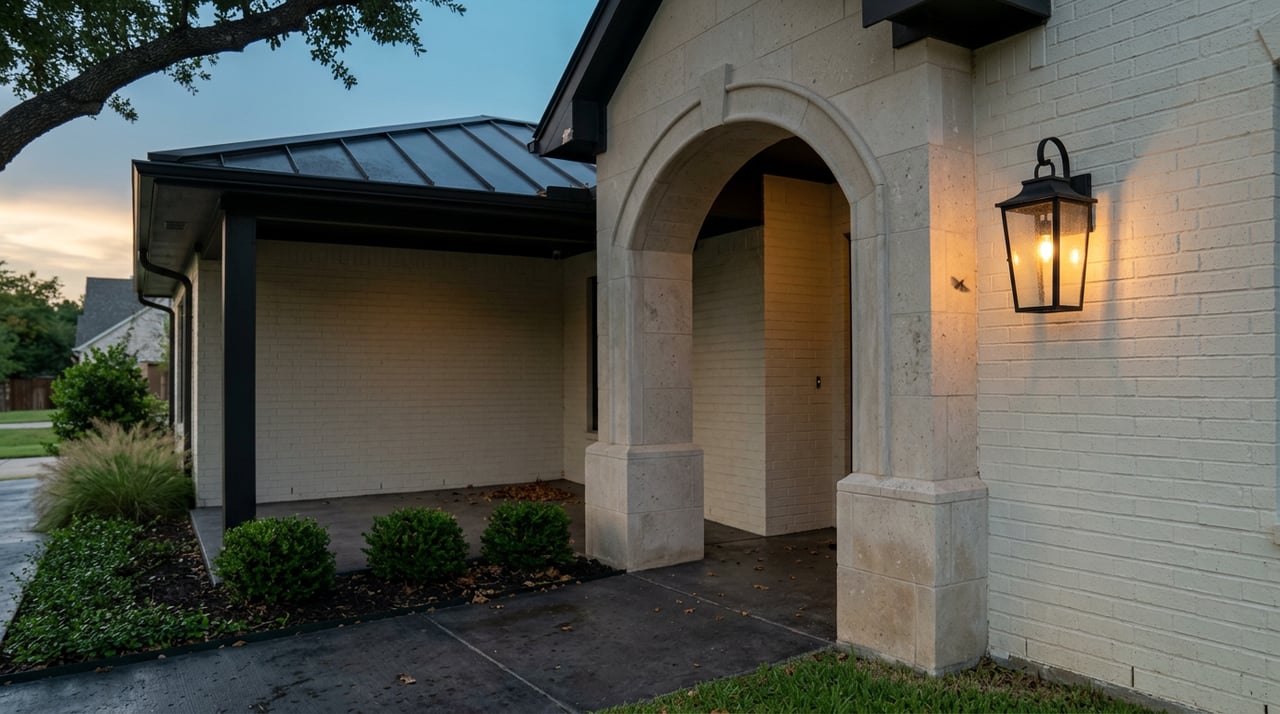

People move to Indigo Lake Estates for the lake. The wooded acreage, the private dock access, the sense that Magnolia's growth is happening somewhere else. What the shoreline doesn't tell you is that closing on a home here means inheriting two ongoing obligations that started before you showed up and don't pause for your transaction: a state-regulated septic maintenance contract that becomes legally yours the moment you sign, and an architectural review process with a documented history of holding homeowners to spec years after they built something.
Neither shows up on the listing sheet in a way that prepares you for it. Both can cost you time, money, or a compliance headache if you don't ask the right questions before your option period ends.
The Utility Line That Isn't the Same on Every Lot
Older write-ups of this neighborhood describe it simply: community water, individual septic, nothing complicated. That description doesn't hold up against what's actually listed today. A 2026 listing for a wooded, two-acre lakefront parcel on Indigo Lake Drive, with 150 feet of shoreline and its own dock and boat launch, lists the sewer as aerobic septic and the water source as a private well, not the community system the older description assumes.
That distinction matters more than it sounds like it should. A conventional septic system is simple: solids settle, liquid disperses through a drain field, and the state doesn't require an ongoing contract to keep it legal. An aerobic system, sometimes required where soil or lot conditions don't support a conventional drain field, is a mechanical system with a pump, an aerator, and a disinfection step, and Texas doesn't treat it as a one-time install. It treats it as an ongoing legal obligation that follows the property, not the person who built it.
Because Indigo Lake Estates mixes lot types, wooded interior parcels, waterfront acreage, older sections built decades ago, you cannot assume which system a given address has. You have to ask for the specific lot.
What Texas Law Actually Requires Once You Own It
Under Texas Commission on Environmental Quality rules (30 TAC Chapter 285) and Texas Health and Safety Code Section 366.0515, every aerobic septic system in the state must be covered by an active maintenance contract with a licensed provider. This is not a recommendation. It is the same category of legal requirement as a smoke detector, except most buyers never hear about it until they own the house.
| Conventional Septic | Aerobic Septic (ATU) | |
|---|---|---|
| Maintenance contract required by law | No | Yes |
| Inspection frequency | No state mandate (pumping every 3–5 years recommended) | Every 4 months (3x per year) |
| Who reports to the county | No requirement | Licensed provider, within 14 days of each visit |
| Typical annual cost (Texas, 2026 guidance) | Roughly $100–$300 averaged over a pumping cycle | Roughly $250–$650 for the contract |
| Obligation at closing | Ends with the sale | Transfers to the new owner immediately |
Montgomery County's own guidance doesn't carve out the two-year exception some Texas counties allow, where a trained homeowner can eventually self-maintain the system. Locally, every aerobic system needs an active professional contract, full stop, for as long as it operates. If the contract lapses, the county can cite the owner. If the system discharges poorly treated effluent, that crosses into a public health violation under state law, not just an HOA notice.
The seller's existing contract does not automatically become yours. In many Texas counties, a new owner is expected to establish their own compliant contract within about 30 days of closing. Before your option period runs out, ask for the current provider's name, the maintenance history, and the county inspection reports. That paperwork tells you whether the system has been kept up or whether you're about to inherit a compressor or aerator on its last year.
The Fence That Turned Into a Two-Year Dispute
Septic systems aren't the only thing this HOA takes seriously. Indigo Lake Estates' deed restrictions specify exact fence construction: 4-inch by 6-inch posts with 2-inch by 6-inch rail boards, with vinyl fencing using 5-inch by 5-inch posts also accepted. In the late 2000s, two homeowners, Roger Hebert and Tammi Wise, found themselves in a prolonged dispute with the Property Owners Association over fences built without prior architectural approval. Hebert's fence, installed in 2006 to secure a home under construction after a burglary, was later found out of compliance; he ended up modifying it to match the current restriction. Wise's fence, installed in 2007, drew the same scrutiny despite a request for approval sent after the fact.
At the time, the association's management representative put it plainly: the issue was never really about post dimensions. It was about the fact that homeowners were building to match what they saw across the road instead of going through approval first.
The specific fence spec is decades old and could have been amended since. What hasn't changed is the underlying pattern: this is a deed-restricted community where the architectural review process is not a formality. If you're planning a fence, a boathouse, a dock modification, or any visible structure after you close, submit it for approval before you build, not after. The precedent here shows the HOA will pursue compliance even years later.
Who's Actually Running Your HOA Right Now
There's a third wrinkle, and it's administrative rather than physical. Public HOA directories list Indigo Lake Estates Property Owners Association, Inc. as managed by Chaparral Management Company, with a resale certificate fee of $250. At least one 2026 property listing in the neighborhood names a different company, Inframark, as the association's management contact. Add in the fact that the 2009 fence dispute was handled by yet a third firm, Association Management Inc., and the pattern becomes clear: this HOA's management has changed hands more than once over its history.
That matters at closing because resale certificates, dues, and ACC applications all route through whichever company is actually active, not whichever one shows up first in a search. If your title company or agent orders a resale certificate from an outdated management contact, you can lose days you don't have during a tight closing window. Confirm the current management company directly with the HOA rather than trusting any single directory, including this one.
What This Means If You're Under Contract Here
- Ask for the septic system type, the maintenance provider, and inspection history for the specific address, not the neighborhood in general, before your option period ends.
- If the system is aerobic, budget the annual contract cost separately from what you'd expect for a conventional system, and plan to establish your own contract promptly after closing.
- Confirm the HOA's current management company directly rather than relying on an older directory or listing sheet, especially before your title company orders the resale certificate.
- If you're planning a fence, dock, or structure after you move in, submit for architectural approval first. The community's own history shows the ACC will revisit unapproved work.
Frequently Asked Questions
Does every home in Indigo Lake Estates have an aerobic septic system? No. Lot conditions vary across the community, and some homes use conventional systems while others, particularly certain wooded or lakefront parcels, use aerobic systems paired with a private well. Confirm the type for the specific address rather than assuming based on the neighborhood.
What happens if I close on a home and the septic maintenance contract has lapsed? The compliance obligation is yours as the new owner regardless of the contract's status at closing. Request the maintenance history before your option period ends, and if the contract has lapsed, budget for an initial inspection and a new contract soon after closing to avoid a county citation.
How do I find out who currently manages the HOA? Contact the Property Owners Association directly rather than relying on a directory listing, since management companies for this HOA have changed more than once. Your agent or title company should verify the current contact before ordering a resale certificate.
If you're weighing a home in Indigo Lake Estates or anywhere in the Magnolia and Montgomery County area, it helps to have someone who checks these details before they become a closing-week surprise. Tiffany Dixon can help you verify septic status, HOA management, and ACC requirements for the specific address you're considering, and walk you through the rest of the process from there. Let's connect and get your questions answered before you're under a deadline.